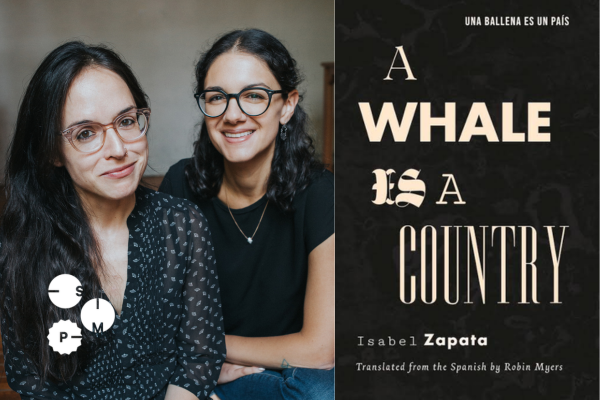
Robin Myers is, in my humble and biased opinion, the best contemporary Spanish-to-English translator working today. When a few years back she shared with me her translation of Isabel Zapata’s Una ballena es un país (A Whale Is a Country in English), I knew soon after reading it that I was interested in publishing Robin’s translation. A Whale Is a Country is a vast compendium of a book. The poems in the book broadly highlight ecology and the environment, but they are also—and maybe chiefly—about wonder. Wonder at animality, but also at sentience, of all kinds. One of the throughlines of A Whale Is a Country is how vast the “natural world” really is. There is naturalness everywhere one looks, in what they see and cannot see. In its entirety, Zapata’s poem “Minor Art” reads, “The microscope,/ window onto the unicellular/ universe.” Humanity exists in a world that is rapidly changing, and this has always been part of life and its millions upon millions of variations.
Although the poetry in A Whale Is a Country treasures the world, it is also a sad book. Rereading it I was reminded of how infinitesimal our time on the planet has been and how, during that time, we have effected such widespread change…and by change I mean death and destruction. Dinosaurs proverbially ruled the world for 150 million years. Humans have been in full-throated existence for just 300,000 years (0.006% of the Earth’s history), but during that time words such as Anthropocene have been invented to note the “change” that has happened in the last two centuries alone. Has happened and is happening. Implicitly, A Whale Is a Country touches on these facts, at what is here now but won’t be in the future, or what is simply not here anymore. Focusing on wonder and awe also necessitates a focus on sorrow, on destitution, in this case due to the senselessness of some of humanity’s whims and follies.
It’s a timeless book, A Whale Is a Country, in the sense that history is timeless, for both good and ill. “More than 99% of all species that ever lived on Earth are estimated to be extinct,” and via climate change and other current widespread developments, the world is currently in the midst of what might be (mildly) called a period of change. We know when it began, this change, but we don’t know when it will end. Who or what will be around in 1,000, 500, or even 200 years is up in the air. Focusing on animality, Isabel Zapata’s A Whale Is a Country captures this ephemerality in vivid lines and images, while also asking a question of the reader: in a world that seems to primarily value money, fame and so-called glory, where do animals fit in? Where should they fit in?
Jeff Alessandrelli, Editor, Co-Publisher, Fonograf Editions